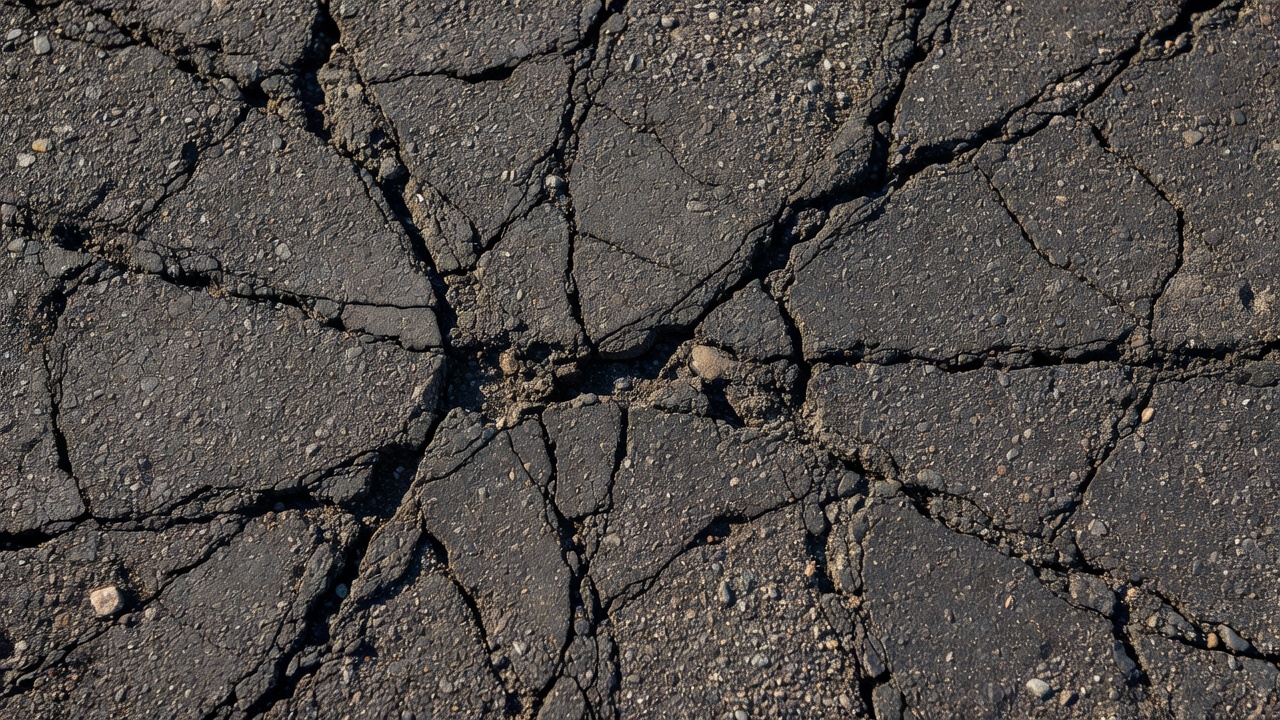
Define the label before the model
Road distress is not one interchangeable category. A longitudinal crack, a construction joint and a sealed repair can resemble one another in an image while requiring different interpretation. Decide which features the survey will report, how severity is assigned and what counts as sufficient evidence. Keep these definitions in the dataset documentation.
The Federal Highway Administration’s Distress Identification Manual for the Long-Term Pavement Performance Program is a useful vocabulary reference. ASTM D6433 describes pavement condition index survey practices for roads and parking lots. Their methods should not be mixed casually: a local contract, pavement type or reporting system may require a particular classification and sampling approach.
A working distress glossary
- Longitudinal and transverse cracking
- Cracks described by orientation relative to the road. Orientation is useful for reporting, but an image alone does not establish the underlying cause.
- Fatigue cracking
- An interconnected pattern associated with repeated loading and pavement response. The visible pattern warrants investigation; it does not by itself quantify remaining structural life.
- Ravelling
- Loss of aggregate or binder at the surface. Lighting and surface texture can influence how clearly this appears in photographs.
- Pothole
- A localised loss of pavement material. Plan-view imagery may show its outline but not provide a trustworthy depth measurement.
- Rutting
- Longitudinal wheel-path deformation. Reliable depth assessment normally requires suitable profile or three-dimensional measurements, not an uncalibrated colour image.
- Patching
- A repaired area that should be recorded distinctly from an untreated defect. Its condition and surrounding deterioration may still matter.
Understand what the algorithm returns
Object detection usually places boxes around candidate features. Segmentation assigns labels to pixels, producing outlines or masks. Classification assigns a category to an image or section. These outputs answer different questions. A box may be adequate for finding an area to review but unsuitable for estimating crack length or distressed area.
Derived quantities require their own checks. Turning a pixel mask into a surface area needs valid scale and geometry. Turning a broken crack trace into a length depends on joining rules and the treatment of gaps. Store the processing method and version alongside the result so comparisons remain interpretable after software changes.
Make uncertainty operational
A confidence score is produced by a particular model under particular training assumptions. It is not automatically the probability that a finding is correct. Changing the threshold changes the balance between false alarms and missed defects. Review that balance for each distress class and intended use, not just as a single headline score.
Precision describes how many reported detections are correct under the chosen matching rules. Recall describes how many reference findings were recovered. Both depend on the reference dataset and evaluation procedure. A model can appear strong on common cracks while missing rare but consequential conditions. Report class-specific results and describe how the sample was selected.
Training and evaluation images should be separated in a way that prevents near-duplicate road scenes from leaking between them. Hold out routes, capture sessions or locations where practical. Include surfaces, weather and camera arrangements representative of deployment. An impressive result from one town or season does not establish performance everywhere.
Give reviewers a useful role
Human review should not consist only of approving the machine’s suggestions. Review a sample of areas with no detections as well, otherwise missed findings remain invisible. Include ambiguous features, repaired sections and low-quality imagery. Where reviewers disagree, record the reason and refine the annotation guide rather than silently choosing one answer.
Keep separate fields for the original model output, the reviewed finding and the final disposition. Useful dispositions include confirmed, rejected, uncertain and not assessable. “Not assessable” is especially important when water, vehicles or shadows obscure the surface. It prevents missing evidence from being interpreted as a healthy road.
Escalate possible immediate hazards through the road operator’s established reporting procedure. Do not wait for a routine model review cycle to resolve a safety concern. For ordinary survey findings, the next step is a traceable location, followed by a maintenance decision supported by more than the defect label alone.